
Dear Phil,
I have pondered your inquiry concerning the location of the Llyswen trolley station1, and am pleased to say that the puzzle is solved.
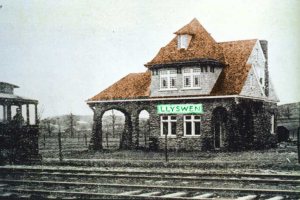 "Llyswen Station."
When I was a youth, not that I am really old now mind you, I was somewhat of an adventurer. No destination was too far, nor was any circumstance too dangerous to quell my curiosity. Of course, I had to be home at supper time or endure my mother's wrath and consequent violent temper, but so long as I stayed within time parameters and did not disclose too much about my activities, I could do just about anything.
My earliest experience with the Altoona Electric Trolley Company was as a passenger. Usually, we would get on the Trolley at the corner on Burgoon Road and Sixth Avenue. That was near what was Trodd's Store, and later the Variety Room Bar.  Across Burgoon Road from the Trodd's was an old Pennzoil gas station with about twelve garage bays with heavy bifold wooden doors. These garages were rented to the occupants of the Knickerbocker row house that did not, for the most part, have garages.
Nothing was quite as exciting to a young lad as looking down the tracks for that single large headlight mounted in the front of the bowed center of the arriving Trolley. 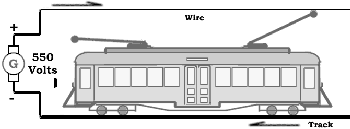 The long arm that rose about ten to twelve feet above the Trolley sparked consistently as it touched the bare wire that was strung from poles along side of the road to fuel the electric engine. Silent except for the humming of the electric motor and the clanking of the metal wheels on the steel tracks, the Trolley would come ever closer until the squealing sound of the brakes sent sparks out from beneath this awesome beast.
The slowing sounds of steel and the glowing spectacle of sparks high above on the wires and from beneath on the brakes, was the signal for my mother to grab my hand and pull me back up on the curb for my own safety. My Uncle Eugene had been killed by a train in London during a "Black Out" in WWII. Every time that the Trolley approached, I was reminded that this could also happen to me if I were not more careful. Fortunately, depending on whether you talk to me or my ex-wife, the same fate that happened to Uncle Eugene never happened to me!
The nice thing about the Trolley tracks was, that if you understood where the Trolley's destination was, you could never get lost. All you had to do was to follow the tracks and they could take you to your destination; never a wrong turn, never a misdirection. Here is an example of what I mean:
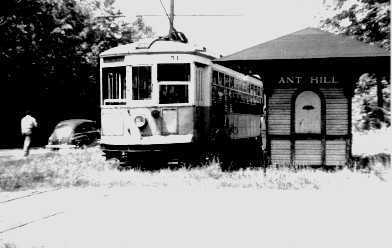 Ant Hill Station.
When I was five years old, I attended Kindergarten at Baker School. I went in the mornings only. My best friend, Davie Headberg, was a year older and was in first grade. Davie had a cousin whom I knew well from his frequent visits to Davie's house named Billy Carol.
One day, as we walked home from school, Davie and I were talking about Billy and how nice it would be if we could go see him. I asked Davie how far it was to Billy's house and Davie said, "Not too far. I go there all the time on the Trolley."
We debated whether or not to tell our parents about our intent, but Davie said that his parents would only say "no" if he asked. That left us with only one choice, don't tell anybody anything. We figured that as long as we got home before dark, it would be OK.
We ate a quick lunch, walked down to the streetcar tracks, and started walking. When we got to the corner of Logan Boulevard and Sixth Avenue, the pavement ended. You may recall that Logan Boulevard used to dead end at Sixth Avenue. There was a dirt road up about four or five blocks, and then the street car had a double lane bridge across the Pennsylvania RR tracks and then the pavement picked up again at Broad Avenue and 31st. Street.
We stopped for a short while where the boulevard ended. Cupples Memorial Company was located on one corner and a Sinclair gas station on the other. Up the dirt road from Cupples there were some deserted old railroad cars. Wow! What fun we had exploring. I can still remember all of those old hornet nests that were built inside the cars as we gazed through broken window glass.
Further up the road, we came to our first real challenge. The road ended and the tracks continued across a double tracked trestle for about one hundred yards. Nothing was beneath the tracks to walk on, except for railroad ties spaced a few feet apart.
PRR Bridge joining Logan Boulevard to Broad Ave.
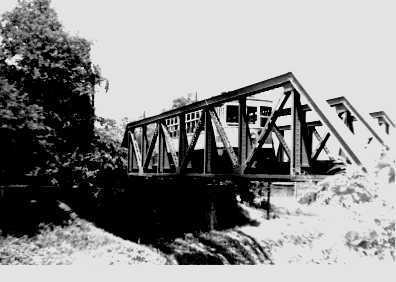 "We could look down and see the main line of the PRR about thirty feet beneath.".
We could look down and see the main line of the PRR about thirty feet beneath. The only option open to us was to balance our way along the rail and get from one tie to the next. About mid-way across, to our horror, we could see a street car coming toward us. It was about four or five blocks away on Broad Avenue. The adrenaline started flowing like water and we speeded up our crossing. We barely made it across in time when the trolley came rolling by. Fortunately for us, the uphill grade to the bridge had slowed the arrival of what may have been our final journey. We took some time to rest on the other side and to tell each other how brave we had been. We were simply very stupid. My mother was right, I almost ended up like my Uncle Eugene!
"We could look down and see the main line of the PRR about thirty feet beneath.".
We could look down and see the main line of the PRR about thirty feet beneath. The only option open to us was to balance our way along the rail and get from one tie to the next. About mid-way across, to our horror, we could see a street car coming toward us. It was about four or five blocks away on Broad Avenue. The adrenaline started flowing like water and we speeded up our crossing. We barely made it across in time when the trolley came rolling by. Fortunately for us, the uphill grade to the bridge had slowed the arrival of what may have been our final journey. We took some time to rest on the other side and to tell each other how brave we had been. We were simply very stupid. My mother was right, I almost ended up like my Uncle Eugene!
Mindful that we needed to get home before dark, we pressed on. We followed the tracks down Broad Avenue and past the Jaffa Mosque to Union Avenue. Onward we pressed, passing the culvert on Union and the tracks went to 12th Avenue and curved to the right. We followed the tracks past Gables and on to 12th Avenue and 11th Street. I was familiar with this area, because my parents attended the Grace Lutheran Church there on the corner. Across 11th Street from the church was the main ticket office of the Trolley Company.3 It was located on the alley in a long and narrow building. As you entered the smelly old building, the barred ticket windows were to your right. A long, straight-backed wooden bench lined the outside wall; to the left where three or four dirty windows which allowed sunlight to enter the otherwise drabby room.
Beside the church was Don's Barber Shop and a Clover Farm or Economy Store. Across the alley from the ticket office was the remains of an old silent movie theatre.2 and next to it a shady looking old rooming house. Next to the rooming house was the Texas Wiener (founded in 1918). Next to it was an arcade of some sort, a couple of other establishments which I cannot recall, and on the corner, the Green Avenue Market.
Across from the Green Avenue Market was Shulman's Department Store and next to it the Corner Sweet Shoppe. The Masonic Temple was above these store fronts.
Anyway, the street cars did not go to Fairview, because of the hills.5 Apparently they did not have enough power for that. One had to transfer at the 11th Street office 5A to a bus to continue to Fairview. We, of course, did not have money for the bus, but as fate would have it, Billy lived directly across the street from Keith Jr. High School which is straight up the hill from 11th Street. After getting a drink of water at the Sweet Shoppe, we started up the hill. I don't know how long it took us to get there, but we were surely tired when we finally arrived at Billy's house.
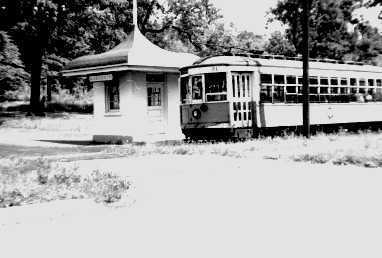 Nazareth Station.
Needless to say, Billy's mom was surprised to see us, but not nearly so surprised as we were when she called my dad and told him that we were there! My dad came to pick us up at supper time, and Davie got his ass whipped. I was scolded, but since I was able to get home by supper time, no existing rules had been broken. Actually, I think my parents were proud of me for walking that far unassisted.
Anyway, getting back to your question. The Llyswen station was located at the corners of Ward Avenue and Logan Boulevard. It stood upon a cement platform between the highway and was one of only two sheltered stations of that type. It had a long narrow wooden building with a roof and a long wooden bench.
The other covered station was at Lakemont Park.4 The trolley service ended at Lakemont Park one block beyond the gated entrance.
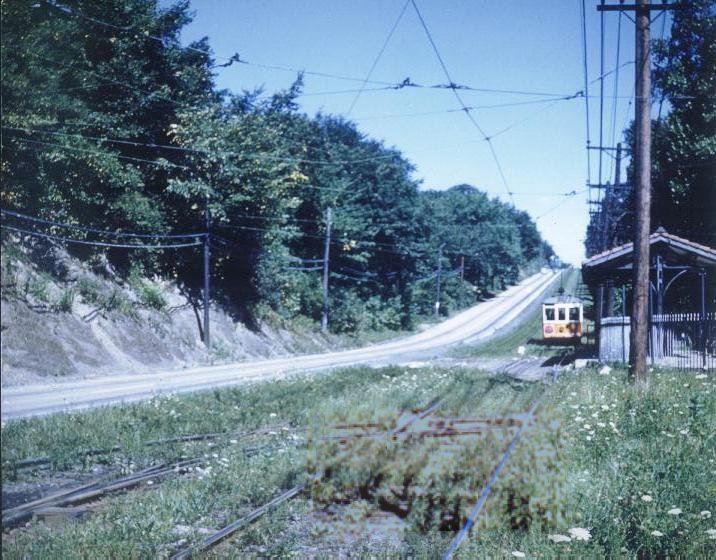 Lakemont Park Station.
Through the gate there was a paved walkway along the end of the lake and across the breast of the dam. An eight foot high wrought iron fence ran along the right side of the walk way. On the other side of that iron fence was the official turn-around area 4A for the street cars. To continue on to Hollidaysburg, one had to pay an additional fee and transfer to a bus, just as was necessary to go on to Fairview.
Lakemont Park Station.
Through the gate there was a paved walkway along the end of the lake and across the breast of the dam. An eight foot high wrought iron fence ran along the right side of the walk way. On the other side of that iron fence was the official turn-around area 4A for the street cars. To continue on to Hollidaysburg, one had to pay an additional fee and transfer to a bus, just as was necessary to go on to Fairview.
The colors of the street cars I do not trust to memory 6 I believe that they were sort of orange and cream and/green. I just cannot remember. Colors were never as important to me as some other facts.
FrankFri, 9 Oct 1998
09:35:14 EDT
In addition to a panoramic memory, Franklin manifests absolute genius in recovering history and restoring clarity to faded dreams. Franklin is a true friend. He writes from his residence in Florida.
As the Student's pen bytewise breaks the surface of the inkwell's modern writing fluid these days, the ink might be new but the well is sourced in a more thoughtful, considerate generation by which one can only reminisce in his love for Miss Beck and all beauty to which many have aspired and in effulgence realized.
- Llyswen Station
218 Logan Boulevard
Altoona, PA 16602 - This was the original passenger station on the Altoona and Logan Valley Electric Railway. It was built by the Altoona Suburban Home Company and appeared in many advertisements for the healthful and aesthetic advantages of suburban living in Llyswen.
- References:
- 1. Dick Lower used to live here. See Frank Lamca's Notes on this.
- 2. HABS Document: LLyswen Station[return]
- THE CITY PASSENGER RAILWAY COMPANY:
- The following is taken from:
-
CLARK'S DIRECTORY
OF THE
City of Altoona, Pa.,
FOR THE YEAR
1890.
Compiled, published and copyrighted for the benefit and convenience of the citizens of Altoona and the business men of Central Pennsylvania,
BY
CHAS. B. CLARK,
IN APRIL, 1890.
N. C. Barclay & Sons, Steam Power Press Printers, 1890. - THE CITY PASSENGER RAILWAY COMPANY, of Altoona,
- Incorporated March 10, 1882.
John P. Levan, president,
L. B. Reifsneider, Secretary and Treasurer;
John J. Buch, Superintendent;
Andrew J. Riley, Solicitor.
Directors:- John P. Levan,
A. J. Anderson,
C. A. Wood,
Dr. C. B. Dudley,
Andrew Kipple,
David Koch,
William Murray, Altoona;
James Lowther, Bellwood;
Max Liveright, Philadelphia.
- John P. Levan,
- Capital stock, $68,000, all paid in.
Length of line, including sidings, 3 miles, 2,674 1/4 feet.
Cost of construction and equipment, $68,375.
Number stables, shops and car houses, 4.
Number cars, 18.
Number horses and mules, 43.
Number men employed, drivers and stablemen, 16 exclusive of officers. The capital stock has just been increased to $150,000 and contracts given out for extending the road from Chestnut avenue and First street eastward to Juniata, and from the present western terminus to and along Broad street to Millville, after which the motive power is to be changed to electricity, and the city will then have nearly eight miles of electric road, giving her citizens facilities for rapid transit to and from all important points and the suburbs.
- Manufacturing Establishments, Incorporated Companies, Etc.http://ftp.rootsweb.com/pub/usgenweb/pa/blair/xmisc/1890altoonabusiness.txt
- Altoona & Logan Valley Electric Railway Company:
- The following is taken from:
-
A HISTORY OF BLAIR COUNTY, PENNSYLVANIA.
CHARLES B. CLARK, ESQ.,
ALTOONA, PA., 1896
COPYRIGHT, 1896 BY CHARLES B. CLARK. -
The street car lines, City Passenger and Logan Valley, motive power electricity since 1891 traverse Eleventh avenue from Ninth to Eighteenth streets, Seventeenth and Bridge streets from Eleventh to Eighth avenues, down the later to Fourth street, thence to Sixth avenue and out Sixth to First street and beyond to Bellwood junction; the entire length of Chestnut avenue from Eleventh street to First street, and beyond to Juniata borough one mile, and Bellwood seven miles northeastward; on Union and Broad avenues, from Eleventh avenue to Thirty-first street, near the new suburb Westmont; from the corner of Seventeenth street and Eighth avenue to Seventh avenue, out Seventh avenue to Twenty-sixth street, and along the street to Fifth avenue; the corner of Twelfth street and Ninth avenue along the avenue to Thirteenth street, along the street to Fifth avenue and along this avenue to Thirty-first street, and southeastward to Lakemont Park three miles, and Hollidaysburg, the county seat, six miles. pg. 63, ibid
- Dates of Important Events in Altoona
The first street railway began carrying passengers July 4, I882; the line extending from First street and Chestnut avenue to Eleventh street to Eleventh avenue, up Eleventh avenue to Bridge street and on Seventeenth street to Eighth avenue to Fourth street. Motive power -- horses and mules; equipment -- six small cars. pg. 79-80, ibid
Electricity was first used here to propel street cars July 4, 1891. The Logan Valley Electric Passenger Railway was completed and passengers carried to Hollidaysburg, June 14, 1893 and to Bellwood, July 1, 1894pg. 80, ibid
- Excerpted from Railroads of Altoona.
ibid
Altoona has two lines of electric cars; both are under one management and the service is very satisfactory.
The first road was built in 1882 by the City Passenger Railway Company and was opened on the 4th of July of that year with a notable demonstration. Electricity was not then in use and horses were the motive power. The line at that time was about three miles long, extending from First street to Eleventh avenue to Bridge street, to Seventeenth street, to Eighth avenue, to Fourth street where the cars were turned on a turn-table and went back over the same route. Soon afterward a branch was constructed from the corner of Eighth avenue and Seventeenth street to Seventh avenue, to Twenty-fifth street.
In 1889 and 1890 a line was constructed from the corner of Eleventh avenue and Bridge street to Eighteenth street, to (Union avenue, to Broad street and along Broad street to city line at Twenty-seventh street. The line was also extended from Fourth street and Eighth avenue, to Sixth avenue, to Lloyd street, below First street.
In 1891 electricity took the place of horses and a power house was erected on Nineteenth street between Ninth and Margaret avenues.
In 1892 the Altoona and Logan Valley Electric Passenger Railway Company was formed and in 1893 they built a line to Hollidaysburg, six miles long.
Early in 1894 they built a line to Bellwood, seven miles.
The Hollidaysburg line begins at the corner of twelfth street and Ninth avenue and extends along Ninth avenue to Thirteenth street, along Thirteenth street to Fifth avenue, along Fifth avenue south-eastward to city line and beyond that to Hollidaysburg.
The Bellwood line extends from the corner of Eleventh street and Eleventh avenue to Ninth street, to Howard avenue, to Third street, to Lexington avenue, to First street, to Chestnut avenue and north-eastward on the country road to Juniata, and from there crossing the railroad, down the valley of the Little Juniata - five miles farther to Bellwood. The Logan Valley, soon after its completion, secured a controlling interest in the City Passenger, and the two roads are now operated practically as one, under the same Superintendent.
In the city cars run six minutes apart, and on the Logan Valley to and from Hollidaysburg, every fifteen minutes, and to and from Bellwood every half hour during the day and until a late hour at night.
Fares in the city, including a transfer if desired, over any of the City Passenger Lines are but five cents, and the same charge is made to Lakemout Park or Llyswen, and ten cents to Hollidaysburg. To Juniata, the fare is five cents and to Bellwood ten cents additional. No transfers are given between the City Passenger and the Logan Valley.
Lines have also been projected on other streets and avenues in the city beside those already noted, and some of them are likely to be built soon, especially one up the Dry Gap along Nineteenth street or on Washington avenue.
The Logan Valley Company laid out and beautified a fine park9 with a large artificial lake at a point midway between Altoona and Hollidaysburg which they called Lakemont, and which has no equal for beauty in the state. It is visited daily in summer time by hundreds and often by thousands of people, and in winter time the lake affords excellent skating, no charge being made for admission at any time.
The rolling stock of the two companies consists of twenty-five closed cars and thirty-six open cars10.
- The number of employees is 175.
The capital stock of the City Passenger is.............. $200,000
And of the Logan Valley, authorized $500,000 issued...... 375,000
Total stock outstanding................................. $575,000
The number of passengers carried in 1895 was 2,800,000.
The officers of both companies are:- JOHN LLOYD, President.
C. A. BUCH, Secretary and Treasurer.
S. S. CRAINE, Superintendent.
- JOHN LLOYD, President.
- Time References
July 4, 1882 The City Passenger Railway Company was incorporated and operations begin. July 4, 1891 First electric car was put in operation. 1892 Altoona and Logan Valley Electric Passenger Railway Company formed. June 14, 1893 Line built to Hollidaysburg, six miles long. July 1, 1894 Line built to Bellwood, seven miles long. 1906 Eldorado route completed (58th Street via Sixth Avenue). February, 1920 Brill Cars, Nos. 31 to 35 arrive in Altoona. See Volume 28, No. 2, Coal Bucket June, 1923 Logan Valley Electric Railway Co. incorporates as the Logan Valley Bus Co. July, 1923 Pleasant Valley route opens. April 9, 1925 A&LVERy Co. purchased by E. E. Fitkin and Co., New York. 1937 Bellwood route lost due to flood. 1946 Fifteen million passenger per annum mark. 1947 First diesel buses July 20, 1953 Service to Juniata discontinued. July 25, 1954 Chartered excursion of the Lehigh Valley Chapter, NRHS (A&LVERy car nos. 51 & 70). August 7, 1954 Last Trolley. December,1956 Altoona & Logan Valley Electric Railway files with PUC to cease operation. November 1, 1959 Operations taken over by Altoona & Logan Valley Bus Authority.
